Forget Seoul's Gwangjang Market —
Here's the K-Food You Can Only Eat in Busan
(May 2026 · Field-Verified · Real Prices · Updated)
Every dish in this guide was bought with my own money. One I'm telling you to skip. And there's a Korea dining secret most tourists never find out about.
When people think of Korean street food, they think Seoul. Gwangjang Market. Bindaetteok, mayak gimbap, tteokbokki.
But Busan has a food identity that Seoul can't replicate — because it was born from a different history. Korean War refugees, American flour aid, port city hunger. The food that survived that era is now on the streets of Nampo-dong and in the backstreet grill houses of Bupyeong.
I spent three days in Busan in May 2026 eating through it. And I learned a dining trick that gets you a free dish at almost any Korean restaurant — which I'm sharing in full below.
📋 Table of Contents
- Ssiat Hotteok — Busan's ₩2,000 street invention
- Dolpan Yangnyeom Gopchang — the Nampo-dong grill experience
- 🎁 Bonus: Korea's Restaurant Review Event — How to Get a Free Dish
- Dwaeji Gukbap — Busan's morning ritual (+ how to eat it correctly)
- Milmyeon — honest assessment + where to go instead
- Jagalchi Market: Raw Fish System Explained
- Full Price & Verdict Summary
- Why Busan Food Tastes Different
01 · Ssiat Hotteok (씨앗호떡) — Busan's ₩2,000 Street Invention
Seoul doesn't have this. Not the real version. Because ssiat hotteok was invented in Busan, and the story of why it exists here is inseparable from why it tastes the way it does.
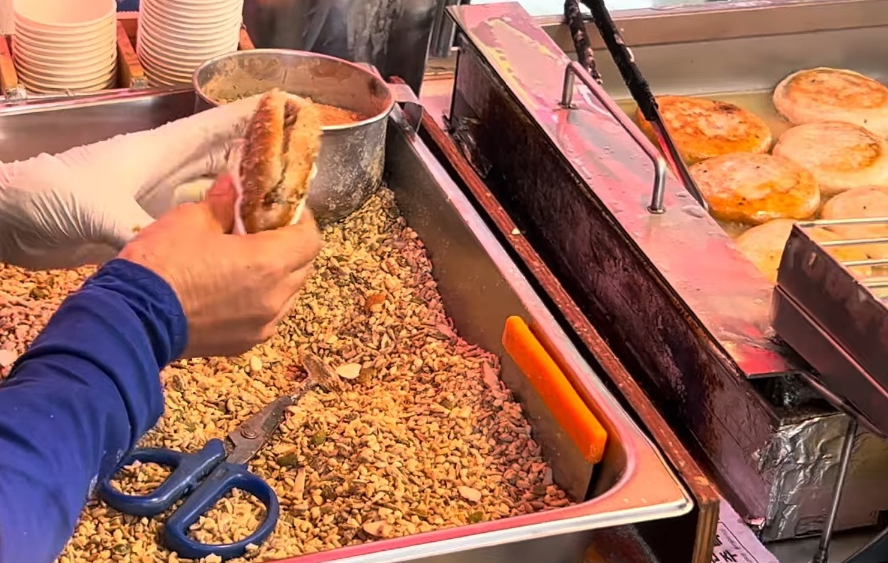
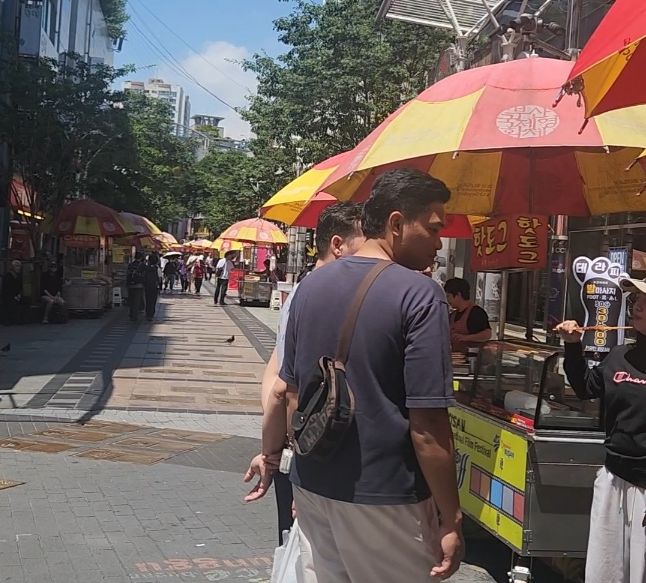
On May 28, after leaving Jagalchi Market, I walked across the street to BIFF Square. I bought one ssiat hotteok, one mulguk tteok (rice cake in fish broth), and one plate of sundae tteokbokki. All standing at the stall, on the street, the way it's meant to be eaten.
The hotteok itself: the shell is pressed flat on a griddle with margarine — this is what gives it the slightly salty, cracker-like crust that sets it apart from any hotteok I've had in Seoul. When you bite in, warm honey flows out together with sunflower seeds, peanuts, and pumpkin seeds. The contrast between the crispy, golden exterior and the molten seeded interior is the whole point. Eat it immediately, standing up, at the stall. The moment it cools, half the experience is gone.
Ssiat Hotteok: ₩1,500 · Mulguk Tteok (rice cake in broth): ₩1,000 · Sundae Tteokbokki: ₩3,000
Total: ₩5,500. You will not find a more satisfying afternoon snack for ₩5,500–₩6,000 anywhere in Korea.
02 · Dolpan Yangnyeom Gopchang (돌판양념 양곱창) — the Nampo-dong Grill Experience
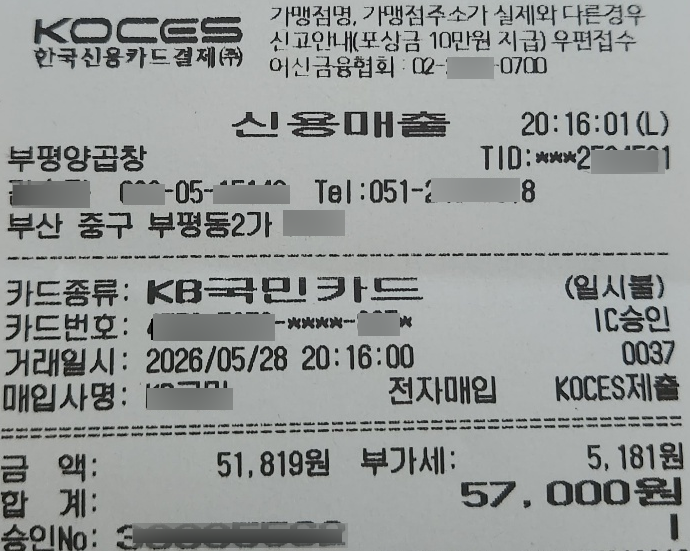
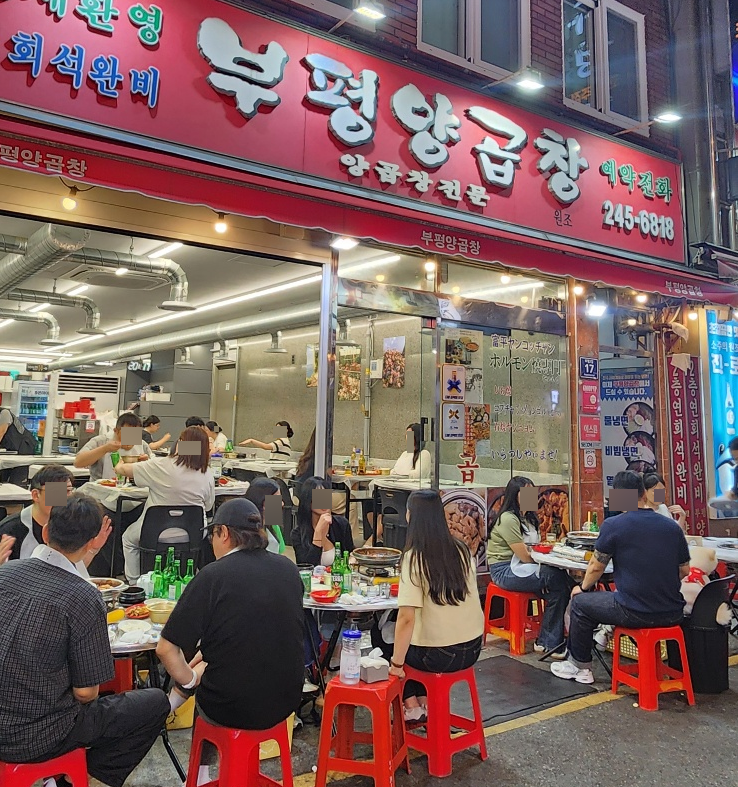
Behind the Bupyeong foot-and-knuckle alley in Nampo-dong, there is a separate gopchang (intestine) street. On the evening of May 28, we didn't search online for a restaurant — we walked in based purely on the crowd already inside and the warmth of the owner's expression at the door. That restaurant was Bupyeong Yanggopchang.
My husband had a bottle of soju. I had water. Total: ₩57,000 for two. We both agreed it was good value for the quality and the experience.
One honest note: gopchang is fatty. While you're eating, it's delicious. When you finish, a small voice asks "was that wise?" That's the gopchang experience everywhere. But sitting in a Nampo-dong backstreet with a sizzling stone plate in front of you is something Busan does that no other city quite replicates.

03 · 🎁 Bonus: Korea's Restaurant Review Event — How to Get a Free Dish
How to Get a Free Dish at Korean Restaurants: The Review Event (리뷰 이벤트)
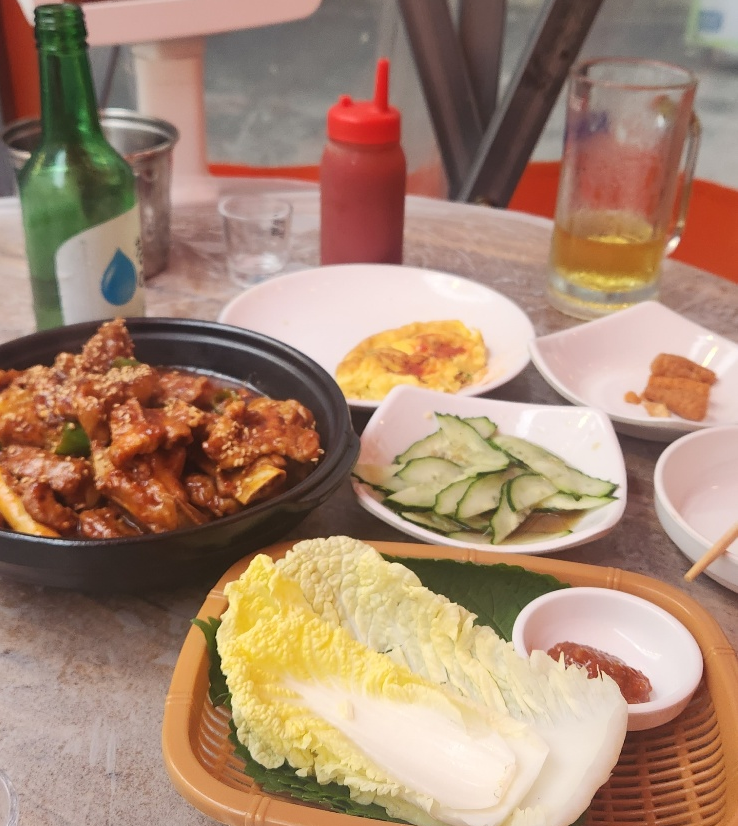
On May 27, my husband and I had dinner at a traditional Korean pub-style restaurant ("Madang", 마당) in Seomyeon. We ordered pork rib stew (돼지갈비찜), egg custard, beer and soju — ₩51,000 total. At the end of the meal, we received a free bowl of odeng soup (fish cake broth) — just for writing a review on Naver Map. That free soup, my husband joked, was the best thing we ate all night.
This is called a 리뷰 이벤트 (Review Event) — and it happens at restaurants all over Korea, especially in Busan and Seoul. Most foreign visitors never find out about it because it's rarely advertised in English. Here's exactly how it works:
- Look for the sign. When you sit down, check the table or walls for a small sign saying "리뷰 이벤트" (review event) or "리뷰 쓰면 서비스" (write a review, get a free dish). If you don't see one, simply ask your server: "리뷰 이벤트 있어요?" (Is there a review event?) Most restaurants running one will confirm it right away.
- Write the review on Naver Map or Kakao Map. Search for the restaurant by name, tap the review button, and leave an honest rating and a few sentences about your experience. Most restaurants ask for a minimum of one photo and 3–5 sentences. You don't need a receipt to post a review on either platform — simply searching the restaurant name is enough.
- Show the server the posted review. They verify it on their phone. Your complimentary dish arrives shortly after — typically a soup, a side dish, or a small appetiser.
- Tip: Write the review during your meal rather than waiting until you leave. That way you receive the free dish before you're finished eating.
⚠️ The complimentary dish is entirely at the restaurant's discretion — you are not guaranteed a specific item. This is a genuine and widely practised Korean dining custom, not a scam. Write an honest review that reflects your actual experience.
04 · Dwaeji Gukbap (돼지국밥) — Busan's Morning Bowl
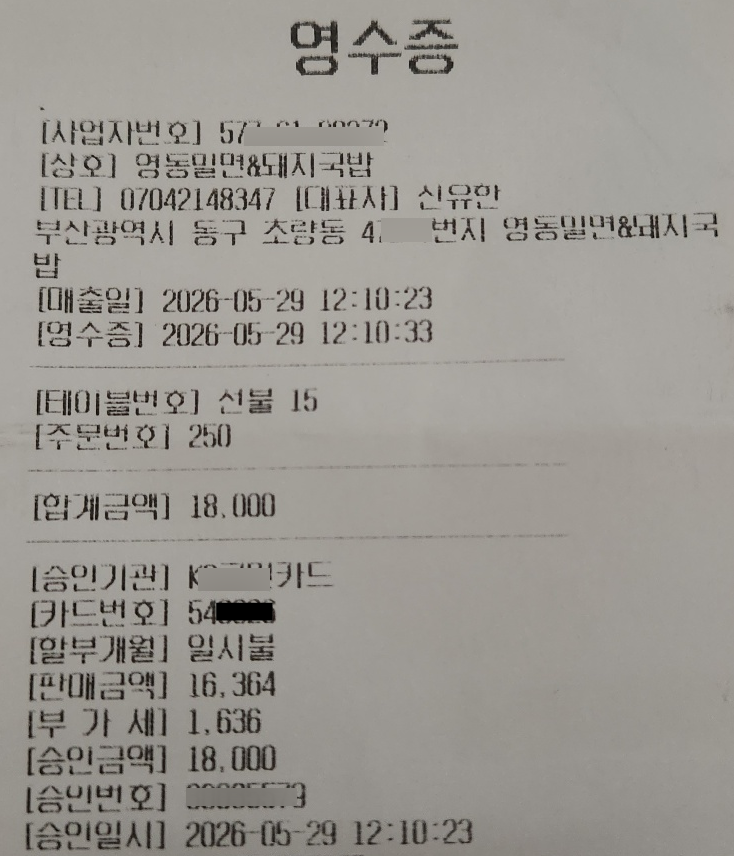
On the last morning of the trip, I walked alone to this restaurant near Busan Station. This is the most Busan way to begin a day — a bowl of milky pork bone broth with rice, eaten quietly before the city fully wakes up.
The gukbap: the broth arrived milky white and hotter than I expected. The flavour was lighter than the colour suggested — clean, not overpowering. I added a small spoonful of salted fermented shrimp (saeujeot) and a pinch of chopped chives. The flavour transformed immediately — the saeujeot deepened the broth in a way that's difficult to describe until you've tried it. The pork slices were tender with no gamey smell. The portion was generous for a solo morning meal. I finished the bowl.
- The rice and broth arrive separately in Busan-style restaurants. Do not wait for someone to mix them — you pour the broth over the rice yourself, or add rice to the broth bowl. Either way works.
- Add saeujeot (새우젓) — salted fermented shrimp. It arrives in a small side dish. Add half a teaspoon to start. It looks intensely salty but it transforms the broth. This is the defining step of the Busan gukbap experience.
- Add chopped chives (부추). These also arrive as a side dish. They cut through the richness of the pork and add freshness.
- Optional: add gochugaru (red pepper flakes) if you want heat. Available at the table in most restaurants.
- Eat while hot. Gukbap cools quickly. Don't wait.

05 · Milmyeon (밀면) — Honest Assessment + Where to Go Instead
That said, milmyeon is a dish absolutely worth understanding — and worth tracking down at the right place.
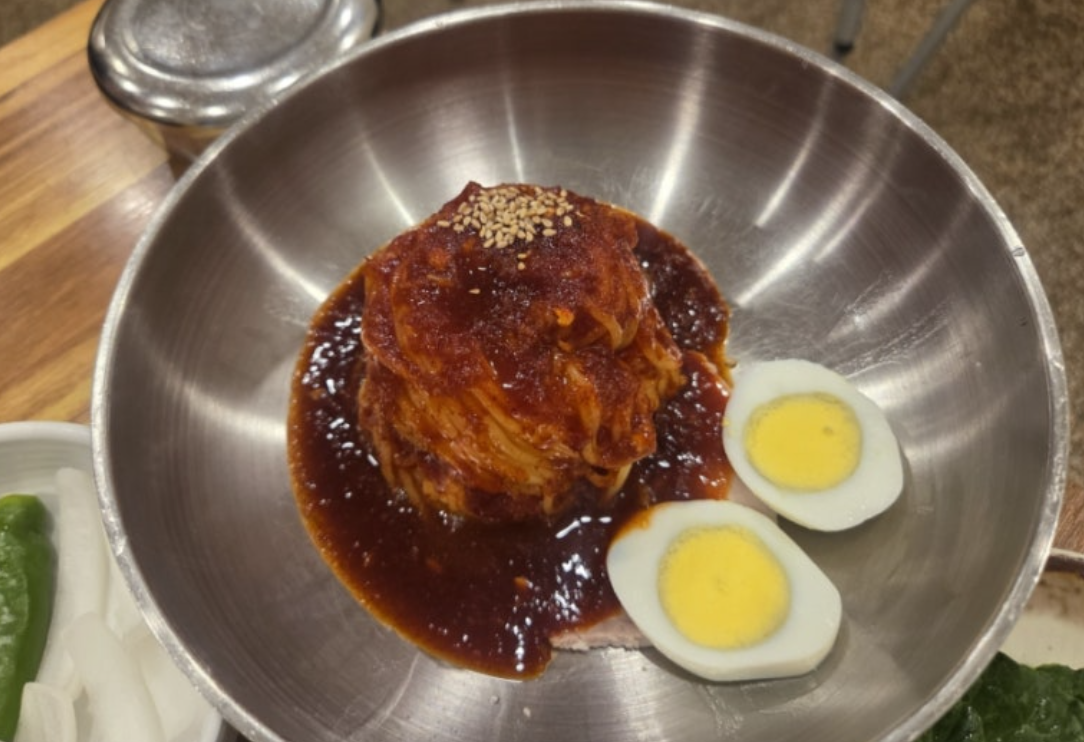
The flavour: a cold noodle broth balancing sour, sweet, and spicy simultaneously. The noodle is thicker and chewier than naengmyeon. This is a summer dish — light, cold, and refreshing — that Busan eats from June through August.
Where to eat proper milmyeon: Go to a milmyeon specialist, not a combined-menu restaurant. Busan's most recommended milmyeon specialists — based on local consensus and verified sources — include the following. Note: I have not personally visited any of these on this trip. These are research-based recommendations which I will verify and update on my next Busan visit.
Gaegeum Milmyeon (개금밀면)
Operating since 1966. Chicken-based clear broth, distinctive spicy-tangy profile. Considered one of Busan's "Big 3" milmyeon spots. Located in Gaegeum-dong.
⚠️ Research-based · Not personally visitedHalmae Gaya Milmyeon (할매가야밀면)
Established 1974. Within walking distance of Nampo Station (Line 1, ~5 min). Menu: water milmyeon & bibim milmyeon only (₩8,000 each). Simple, focused, easy to reach from BIFF Square. Source: VisitKorea official listing.
⚠️ Research-based · Not personally visitedChoryang Milmyeon (초량밀면)
Choryang-dong area, walkable from Busan Station. Frequently cited in local guides as an accessible, reliable option for first-time milmyeon visitors. Source: TripAdvisor listing.
⚠️ Research-based · Not personally visited06 · Jagalchi Market: The Raw Fish System Explained
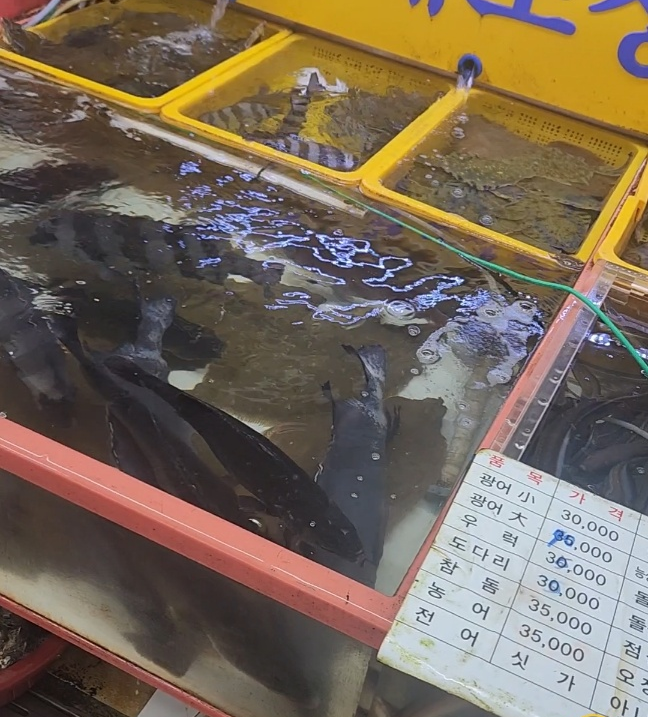
Field-verified May 28, 2026 — system and pricing inspected on-site. I did not eat here on this visit.
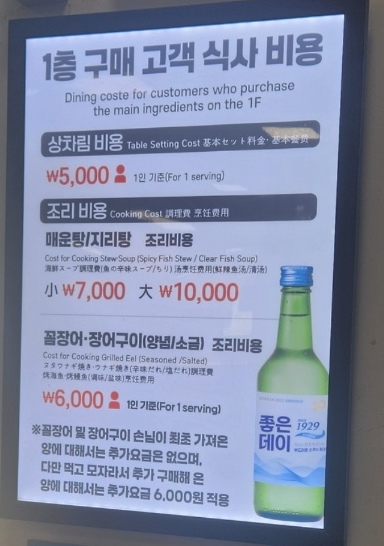
On May 28 I spent time on both floors of Jagalchi Market specifically to document how the system works for foreign visitors. I photographed the pricing signage, inspected the 2F dining area, and confirmed the fee structure directly. Here is what I verified.

07 · Full Price & Verdict Summary
| Food | Location | Price (May 2026) | Verdict |
|---|---|---|---|
| Ssiat Hotteok | BIFF Square stalls, Nampo-dong | ₩1,500–₩2,500 ₩2,000 most common |
✅ Strongly recommended |
| Mulguk Tteok + Sundae Tteokbokki | BIFF Square stalls | ₩1,000 + ₩3,000 | ✅ Recommended |
| Dolpan Yangnyeom Gopchang | Bupyeong Yanggopchang, Nampo-dong | ₩57,000 / 2 people incl. soju | ✅ Strongly recommended |
| Seomyeon pub dinner (+ Review Event free soup) |
"Madang" (마당) pub, Seomyeon | ₩51,000 / 2 people | ✅ Recommended · Try the review event |
| Dwaeji Gukbap | Yeongdong, 472 Choryang-dong | Receipt confirmed (see photo) | ✅ Recommended |
| Milmyeon | Same restaurant (Yeongdong) | Receipt confirmed (see photo) | ⚠️ Did not meet expectations on this visit → Go to a specialist instead |
| Sashimi + table fee | Jagalchi Market 1F + 2F | Fish per kg (varies) + ₩5,000/person | ⚠️ System verified · Not eaten this visit |
| Maeuntang (spicy soup) | Jagalchi Market 2F | ₩7,000 small / ₩10,000 large | ⚠️ Price verified · Not eaten this visit |
08 · Why Busan Food Tastes Different
Looking back at everything I ate on this trip, a single thread runs through all of it.
Ssiat hotteok was invented by refugees stretching their food with grain seeds and margarine. Milmyeon was created by a North Korean woman who couldn't find buckwheat and used American aid flour instead. Dwaeji gukbap was the meal that kept people alive through wartime winters on pork bones and boiling water. Even gopchang — offal, the cheapest cut — found its way into a street of dedicated restaurants in a port city that couldn't afford to waste anything.
Gwangjang Market in Seoul is famous for a reason. But the food in Busan's backstreets carries a history that no food hall in Seoul can replicate — because it grew from a different kind of hunger, in a city at the edge of the sea, during the worst years of the 20th century.
Go to BIFF Square. Buy a ₩2,000 hotteok. Ask if there's a review event. Stand on the street, eat it while it burns your fingers, and write the review while the honey is still on your hands. That's where to start.

📌 Sources & References
- Personal field visits, receipts & on-site observation — Busan, May 27–29, 2026 (Nampo-dong, BIFF Square, Jagalchi Market, Seomyeon, Busan Station area)
- Ssiat Hotteok origin — National Culture Research Institute (ncms.nculture.org): "From the western steppe to Busan's signature food"
- Encyclopedia of Korean Culture (encykorea.aks.ac.kr) — Ssiat Hotteok historical entry
- Ssiat Hotteok price range (BIFF Square 2026) — Trip.com Busan BIFF Square food guide (May 2026 update): ₩2,000–₩3,000 range cited
- Milmyeon origin — Visit Busan official (visitbusan.net): "Milmyeon: Busan's summer taste"
- Milmyeon & Korean War — National Culture Research Institute: "6.25 and the birth of milmyeon" · Busan City official milmyeon story
- South China Morning Post — "How Busan's milmyeon tells the story of Korean War refugees" (2023)
- Halmae Gaya Milmyeon — official listing: VisitKorea (Korea Tourism Organization)
- Choryang Milmyeon — listing: TripAdvisor
- Milmyeon specialist recommendations — Staylog.co.kr "Busan Milmyeon Top 3" · DiningCode May 2026 rankings · Korea Tourism Organization (visitkorea.or.kr)
- Jagalchi Market pricing — On-site signage verified May 28, 2026 (photographed)
- Fish-switching documentation — Reddit r/koreatravel (multiple threads, verified)
- Bupyeong Yanggopchang — Naver Map · Address: 34 Junggu-ro 29beon-gil, Jung-gu, Busan · Sun–Fri 11:30–23:00, Sat 11:30–02:00
- Yeongdong Milmyeon & Dwaeji Gukbap — Naver Map · 472 Choryang-dong, Dong-gu, Busan · Daily 10:00–20:30
- Review Event (리뷰 이벤트) custom — Confirmed via personal experience (May 27, 2026) · Cross-referenced: r/koreatravel discussion · Naver Map guide for tourists (korealocally.com)
Food assessments: All dish assessments reflect the author's personal experience on a single visit. The milmyeon assessment ("did not meet expectations") applies exclusively to one order at Yeongdong Milmyeon & Dwaeji Gukbap (Choryang-dong) on May 29, 2026, and does not constitute a general characterisation of the restaurant or of milmyeon as a category. Milmyeon specialist restaurant suggestions (Gaegeum, Halmae Gaya, Choryang) are research-based and were not personally visited by the author on this trip — visit at your own discretion and verify current hours and prices before going.
Review Event (리뷰 이벤트): The review event practice described in this guide reflects a personal experience and widely documented Korean restaurant custom. Always write honest reviews that reflect your genuine experience. The author does not encourage or endorse fake or incentivised reviews that misrepresent a dining experience.
Alcohol: References to soju and beer in this guide appear strictly in the context of personal dining experience documentation. Nothing in this guide constitutes a recommendation to purchase or consume alcohol.
Independence: The author receives no compensation, free meals, complimentary visits, or any other benefit from any restaurant, market, or organisation mentioned in this guide. VibeKorea is an entirely independent blog with no commercial affiliations.
About this blog · Privacy Policy


