The night before I arrived at Jagalchi Market, the President of South Korea was eating there — and telling the nation it has an overcharging problem.
On May 26, 2026, President Lee Jae-myung and the First Lady walked the 1st floor of Jagalchi Market in Busan. They bought sea pineapple, squid, tiger shrimp, and sea cucumber. They ate upstairs. And then — in front of cameras — the President said this:
It made national news the next morning. I arrived the morning after that.
So here is the honest answer to the obvious question: Is Jagalchi Market still worth visiting? Yes — but only if you know exactly what to do, what to avoid, and how to eat like someone who did their homework. The difference between a ₩180,000 disappointment and a ₩45,000 unforgettable meal comes down to a handful of decisions made in the first ten minutes. This guide gives you every one of them.
📋 Table of Contents
- What Is Jagalchi? — History & Layout at a Glance
- The Honest Truth — Why Some Visitors Get Overcharged
- How It Actually Works — The Chojangzip System Explained
- The 3 Rules That Protect Your Wallet
- Real Price Guide — May 2026
- What to Order Right Now — Spring & Early Summer Seafood
- Best Time to Visit & Opening Hours
- Getting There — Subway, Taxi & Parking
- If Jagalchi Disappoints — Sindonga Market & Cheongsapo
- FAQ
01. What Is Jagalchi? — History & Layout at a Glance
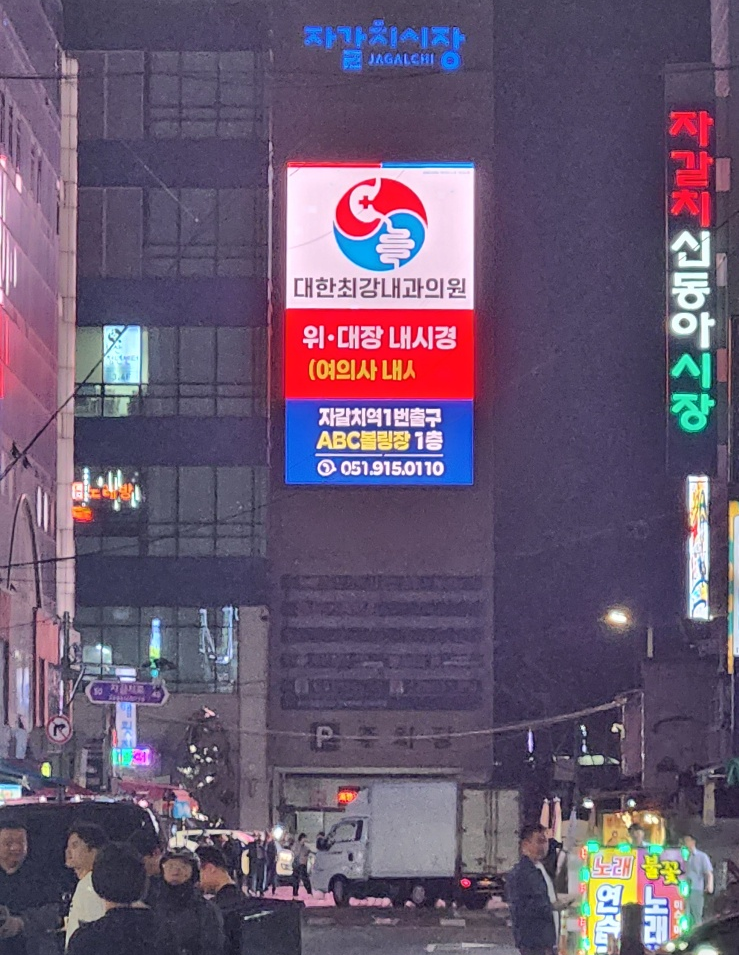
Address: 52 Jagalchi-haean-ro, Jung-gu, Busan. The name comes from the small pebbles (jagal, 자갈) that once covered this stretch of coastline. Fish vendors began gathering here in the 1920s on the quayside outside the docks. After liberation in 1945 and the Korean War, a wave of refugees swelled the stalls into a full market. In 2006 the current glass-fronted modern building opened. A ₩1 billion renovation completed in April 2023 rebuilt the ground floor, replaced ageing plumbing, and refurbished the staircases.
Understanding the layout is the single most important preparation you can make.
The modern building has 8 floors, but only two actually matter for visitors:
- 1st floor — live seafood in tanks, whole fish, and vendors. This is where you choose and pay for your seafood.
- 2nd floor — the chojangzip (초장집) dining area. This is where you eat what you bought downstairs.
Outside the building, along Jagalchi-haean-ro, an outdoor stall section runs parallel to the waterfront. This “outer Jagalchi” opens earliest in the morning and is where you’ll find the most local atmosphere. The 3rd floor holds the vendors’ association office; the 7th floor has a guesthouse.

02. The Honest Truth — Why Some Visitors Get Overcharged
Most travel blogs describe Jagalchi Market as “a paradise of fresh seafood.” Visitors who arrive with only that information are the ones who end up posting about it on Reddit.
South Korean President Lee Jae-myung visited Jagalchi Market the evening of May 26, 2026 — one day before my own arrival. He and First Lady Kim Hye-kyung toured 1st-floor stalls, personally purchasing sea pineapple (멍게), squid, cuttlefish, tiger shrimp, and sea cucumber before dining on the 2nd floor.
At the visit, the President publicly stated: “The moment tourists start showing up, prices get inflated.” The remark, aimed at Korea’s broader tourism overcharging culture, made national headlines on May 27 — the morning I walked into the same market. (Source: Yonhap News, May 26, 2026; Chosun.com English, May 26, 2026)
This wasn’t an isolated presidential concern. In September 2025, Korea’s major broadcasters — KBS, JTBC, Yonhap News, and Chosun Ilbo — ran simultaneous reports on overcharging at Jagalchi Market after a restaurant charged ₩70,000 for a single plate of sea cucumber without displaying legally required price boards. The story went national. Busan’s Jung-gu district office launched inspections. The Jagalchi Merchants’ Association held a public “Anti-Overcharging Declaration Rally” on September 5, 2025.
Around the same time, on Reddit’s r/koreatravel (215,903 subscribers), a post titled “Disappointed by Jagalchi Market” attracted 44 comments:
“I ordered a wild sashimi and some shrimp. When the food arrived the wild fish didn’t look wild at all. The grilled shrimp tasted gummy — I’m used to eating a lot of shrimp and I could tell it wasn’t fresh. The price was ₩100,000. I told the server, he smirked, said he’d talk to the boss, and came back with the bill instead.”
Top comment from a Korean local (53 upvotes): “Jagalchi is unfortunately a tourist trap.”
Korean commenter (8 upvotes): “Jagalchi Market is so badly overpriced that it was even recently featured in the news in Korea. Don’t bother going to the market — just go to a restaurant that sells the food you want.”
Another Korean commenter (6 upvotes): “Koreans usually avoid places like that. They’re expensive and outdated, mostly targeting tourists who don’t know better.”
Does all of this mean you should skip Jagalchi? No.
When I visited on May 28, 2026, I found that the post-2025 crackdown had made a real difference. The majority of 1st-floor stalls displayed per-kilogram price boards. The 2nd-floor restaurant I sat in had a clearly printed menu showing the ₩5,000/person table fee and ₩5,000–10,000 cooking charges. The seafood I saw was visibly fresh. The system works — when you know how to use it.
The people who get overcharged are almost always the people who walked in without reading anything like this first.
03. How It Actually Works — The Chojangzip System Explained
Jagalchi Market operates on a system that is fundamentally different from a regular sashimi restaurant — and not understanding it is the single biggest source of confusion and unexpected bills. The system is called the chojangzip system (초장집 시스템): buying space and eating space are separated across two floors.
1F — Choose Your Seafood
Walk the entire 1st floor at least once before buying anything. Look at the live tanks, compare price boards, and choose what you want. When you’ve decided, tell the vendor. If there’s no price board, ask directly: “얼마예요?” (eol-ma-ye-yo) — “How much is it?” If the answer is vague or they try to get you seated before quoting a price, move to the next stall. Once agreed, the vendor takes the seafood out of the tank and weighs it on the scale in front of you. Do not look away during this step.
1F → 2F — The Walk Upstairs
After payment, the vendor carries your seafood up to the affiliated 2nd-floor restaurant and shows you to a seat. This transition is the most common point where switching occurs — the seafood you chose gets swapped for a lower-quality piece or a smaller crab on the way up. Either carry it yourself, or watch until the vendor sets it down at your table.
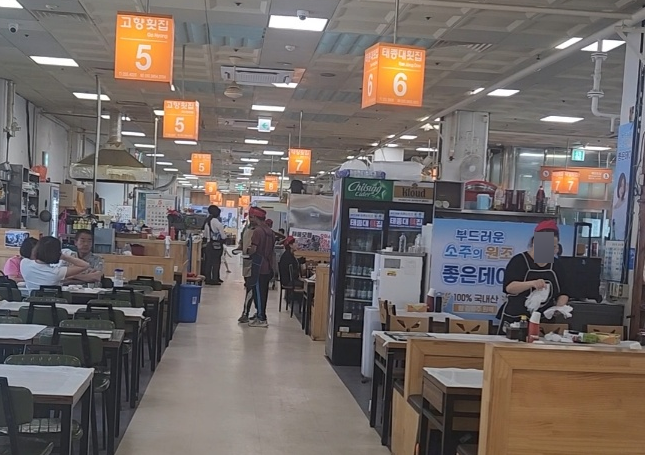
2F Chojangzip — Sit & Eat
Once seated, basic side dishes are set up: ssam vegetables, chojang dipping sauce, ssamjang, and a small soup (usually doenjang-guk or miyeok-guk). This is the “table fee” (상차림비) — ₩5,000 per person. Confirmed on-site, May 28, 2026. The fish is sliced fresh from what came up from downstairs and brought to your table. If you want it steamed, grilled, or in a stew, an additional cooking charge (₩5,000–10,000) applies.
When you’re most of the way through your sashimi, ask the restaurant to make a spicy fish soup from the bones, head, and offcuts of your fish. Extra cooking charge: around ₩8,000–10,000. Many visitors say this soup was the best part of the meal — and it’s one more way to verify you got what you paid for: if the fish in the soup matches what you chose downstairs, you weren’t switched.
What Costs What — The Complete Bill Breakdown
| Charge | Amount | When It Applies |
|---|---|---|
| Seafood (1F purchase) | Market rate (per kg or per piece) | Always — negotiated and paid downstairs |
| Table fee (상차림비) | ₩5,000 per person | Always — covers side dishes and table setup |
| Cooking charge (조리비) | ₩5,000–10,000 per item | Only if you request steaming, grilling, or stewing |
| Spicy fish soup (매운탕) | ₩8,000–12,000 | Optional but strongly recommended |
| Drinks (beer/soju) | ₩4,000–6,000 | Per item; varies by restaurant |
04. The 3 Rules That Protect Your Wallet
Korean regulars at any seafood market follow these without thinking. They are almost never written in English-language travel guides. That gap is exactly why this blog exists.
The grey italic text is what Korean locals and verified sources consistently recommend — drawn from staylog.co.kr, Korean-language seafood market guides, and r/koreatravel local commenters. This is research.
The yellow ✍️ box is what I personally observed or did on May 28, 2026 at Jagalchi Market. This is first-hand experience. They are two different types of information and I have kept them visually separate.

Rule 1 — “Drain the basket before you weigh it.”
When seafood is lifted from a water tank and placed on the scale, a basket full of water can add several hundred grams of false weight — and you pay for all of it. Honest vendors use a perforated draining basket automatically. If yours doesn’t, say this:
| 바구니 물 빼서 달아주세요. | Ba-gu-ni mul bbae-seo da-ra-ju-se-yo. | “Please drain the basket before weighing.” |
I watched three separate transactions at different 1F stalls during my visit. Two vendors used perforated baskets as standard — water drained automatically before the seafood reached the scale. The third vendor did not. When the customer ahead of me said nothing, the dripping basket went straight onto the scale. When I made my own purchase at a fourth stall and used this phrase, the vendor immediately switched to a perforated basket without friction or irritation. No drama, no pushback — the request was treated as completely normal.
Rule 2 — Don’t take your eyes off your seafood.
“Just go sit down, we’ll bring it right up” — don’t relax at these words. Either carry the seafood upstairs yourself, or keep visual contact until the vendor sets it on your table. If the fish in your spicy soup at the end doesn’t look like what you chose, that’s your confirmation something went wrong.
I did not witness a direct switching incident during my visit. What I did observe: at a neighbouring stall, a group of foreign tourists went upstairs first while the vendor disappeared with their crab into the back of the stall — out of direct sight for roughly 90 seconds before reappearing at the staircase. I cannot say what happened during those 90 seconds. What I can say is: the risk window is real and clearly identifiable. The solution is simple — stay in visual contact or carry it yourself.
Rule 3 — Walk the whole floor first. Every time.
The most expensive mistake in any market is buying from the first vendor who calls out to you. The correct response is a polite nod and to keep walking. Once you’ve seen the full floor, compared prices, and assessed freshness across at least five or six stalls, then you choose.
I spent approximately 25 minutes walking the full 1F floor before buying anything. I counted price boards at 31 stalls: 22 had clearly written per-kg prices on whiteboards or LED boards; 9 had no posted price. I was called out to by vendors at every aisle — none were aggressive. A polite nod and continued walking was always sufficient. The stall I eventually chose had the clearest price board and the most active tanks. The asking price was ₩28,000/kg for spring flatfish. I did not negotiate — the price seemed fair given what I had seen at surrounding stalls.
05. Real Price Guide — May 2026
The figures below are cross-referenced from four independent sources:
- On-site observation — personal visit, May 28, 2026 (spring flatfish, table fee, cooking charge confirmed directly at the stall and restaurant I used)
- 인어교주해적단 (tpirates.com) — real-time national seafood price platform, May 2026
- 자갈치시장 총각상회 Instagram @chong_gak_jagalchimarket — vendor’s own daily price posts, May 2026
- Reddit r/koreatravel — price reports from visitors, May 2026
| Item | May 2026 Reference Price | Source & Notes |
|---|---|---|
| Spring flatfish (봄 도다리) | ₩20,000–35,000/kg | ✅ Personally confirmed May 28 — paid ₩28,000/kg at the stall I purchased from. In season — order as 세꼬시. |
| Snow crab (대게) | ₩40,000–60,000/kg | Late-season. 총각상회 May 6, 2026 post confirms market range. |
| King crab (킹크랩) | ₩90,000–140,000/kg | High volatility; some days sold out. Check tpirates.com before visiting. |
| Flathead flounder (광어) | ₩20,000–40,000/kg | Wild vs. farmed gap is significant. Ask: 자연산이에요, 양식이에요? (Wild or farmed?) |
| Live octopus (산낙지) | ₩15,000–25,000/piece | Size-dependent. Confirmed range via r/koreatravel May 2026 reports. |
| Live squid (산오징어) | ₩8,000–15,000/piece | ✅ Seen in tanks on May 28, 2026. Coming into season from May. |
| Table fee (상차림비) | ₩5,000/person | ✅ Personally confirmed May 28, 2026 — printed on the 2F menu at the restaurant I sat in. Also consistent with staylog.co.kr and TripInfo. |
| Cooking charge (조리비) | ₩5,000–10,000/item | ✅ Personally confirmed May 28, 2026 — printed on the same 2F menu. Per item steamed/grilled/stewed. |
| Spicy fish soup (매운탕) | ₩8,000–12,000 | Extra cooking charge. Strongly recommended. Consistent with staylog.co.kr. |
| Drinks (beer/soju) | ₩4,000–6,000 | Per item; varies by restaurant. |
Spring flatfish (봄 도다리), approx. 600g at ₩28,000/kg → ₩16,800
Table fee × 2 → ₩10,000
Spicy fish soup (매운탕) → ₩10,000
Beer × 2 → ₩10,000
Total: ₩46,800 for two people. A full meal — sashimi, soup, side dishes, drinks — for under ₩50,000. This is what “knowing the system” looks like in practice.
Smart seasonal meal: Spring flatfish + table fee ×2 + spicy soup = ₩35,000–55,000
Add one snow crab (1kg): Total ₩75,000–115,000
Red flag threshold: Bill over ₩150,000 for 2 people → ask for a line-by-line itemised receipt immediately.
06. What to Order Right Now — Spring & Early Summer Seafood
Ordering salmon or farmed flounder at Jagalchi is a missed opportunity. You can get those at any neighbourhood sashimi restaurant in Korea, often cheaper. The locals who eat well at Jagalchi always target seasonal seafood. Here’s what May 2026 means for your plate.
🌸 Spring Flatfish — 봄 도다리 (March–May) | Last chance of the season
There’s a Korean saying: “봄 도다리, 가을 전어” — spring flatfish in spring, large-eye herring in autumn. After overwintering, spring flatfish reach peak fat content and flavour in March–May. Order it as 세꼬시 (sekkosi) — bone-in thin slices — and each bite releases a deep, nutty richness that the boneless version can’t replicate. Price on May 28, 2026: ₩20,000–35,000/kg. More affordable than crab; arguably more interesting in May.
🐟 Gijang Anchovy Sashimi — 기장 멸치회 (Spring–Early Summer)
Anchovies caught off Gijang, just east of Busan, are considered the finest in Korea. In spring they’re served as melchiwhoe (멸치회) — marinated in a spicy-sweet sauce — and you’ll find them at outdoor stalls around the market. Around ₩10,000 a plate. Almost no foreign visitors order this, which means it’s almost never sold to tourists at tourist prices. It’s also the most memorable “I didn’t know you could eat that” experience at the market.
🦑 Live Squid — 산오징어 (May onward)
From May, live squid (산오징어) start coming into season. A genuinely fresh live squid is translucent — nearly see-through — and the texture is unlike anything from a frozen or stored specimen. It’s typically sliced into thin strips and eaten wrapped in perilla leaf with dipping sauce, or served still moving in a bowl with gochujang. This is an experience unique to a market with live tanks.
07. Best Time to Visit & Opening Hours
Official Opening Hours Source: Busan Facilities Corporation — Jagalchi Market official site, verified May 2026
| Area | Hours |
|---|---|
| Whole building (official) | Daily 05:00–22:00 |
| 1F fish vendors (practical) | ~09:00 open, ~21:00–22:00 close |
| 2F chojangzip restaurants | ~09:00 open, ~21:00–22:00 close |
The 1st-floor fish market and 2nd-floor restaurant area close on the 1st, 3rd, and 5th Tuesday of every month. Also closed on Lunar New Year’s Day + the following day, and Chuseok Day + the following day.
Always confirm at the official source before you go:
👉 bisco.or.kr/jagalchimarket — Busan Facilities Corporation official Jagalchi Market page
Why this matters: Some individual stalls follow “1st and 3rd Tuesday only,” and several third-party travel sites repeat this incorrectly. The building-wide official schedule confirmed by Busan Facilities Corporation is 1st, 3rd, and 5th Tuesdays. This discrepancy has caused visitors to arrive on a closed 5th Tuesday expecting an open market.
May 28 was a Thursday. I checked the official Busan Facilities Corporation page the evening before my visit to confirm it was not a closed Tuesday. The May 2026 closed Tuesdays were May 6, May 20, and May 27. Had I gone on May 27 instead of May 28 — one day earlier — the building would have been closed. This is exactly why I recommend checking the official calendar rather than relying on any travel blog, including this one.
When to Go — and When to Avoid
Morning fish fresh from overnight boats
Before the tourist lunch rush
Relaxed vendors, easier comparison
Summer holiday lunch 12:30–14:00
Peak tourist season (Jul–Aug)
Vendor pressure highest when crowded
I arrived at approximately 10:30 AM on a Thursday. The 1F floor was active but not crowded — I was able to walk the full floor twice without being blocked or pressured. By the time I came back down after eating (approximately 13:00), the lunch rush was clearly building: groups of tourists were arriving in clusters and several stalls had queues forming. The 10:00–11:30 window on a weekday was noticeably calmer and better for unhurried comparison shopping.
08. Getting There — Subway, Taxi & Parking

🚇 Subway — Strongly Recommended
Busan Subway Line 1 (orange) → Jagalchi Station, Exit 10 → 3 minutes on foot to the market entrance. Nampo Station (Exit 2) is also walkable in ~5 minutes.
From Haeundae: Line 2 (green) Haeundae → transfer at Seomyeon → Line 1 → Jagalchi (~50 min, ~₩1,700 with transit card)
From Busan Station (KTX): Line 1 → Jagalchi (5 stops, ~10 min, ~₩1,400)
Need a transit card? → See the complete Busan subway card guide for foreigners
🚕 Taxi
From Haeundae: ~30–40 min, ₩18,000–22,000
From Busan Station: ~10 min, ₩5,000–6,000
Use Kakao T app for an upfront fare estimate and to avoid overcharging.
🚗 Driving & Parking
Underground parking directly below the market building. Public parking lot immediately in front of the entrance: ~₩500 per 10 minutes.
Ask for a parking discount voucher when paying for your 1F purchase or 2F meal — this is standard and widely available. Do not forget to ask.
⚠️ Weekends and public holidays: severe traffic around the market. Public transport is much easier.
09. If Jagalchi Disappoints — Sindonga Market & Cheongsapo
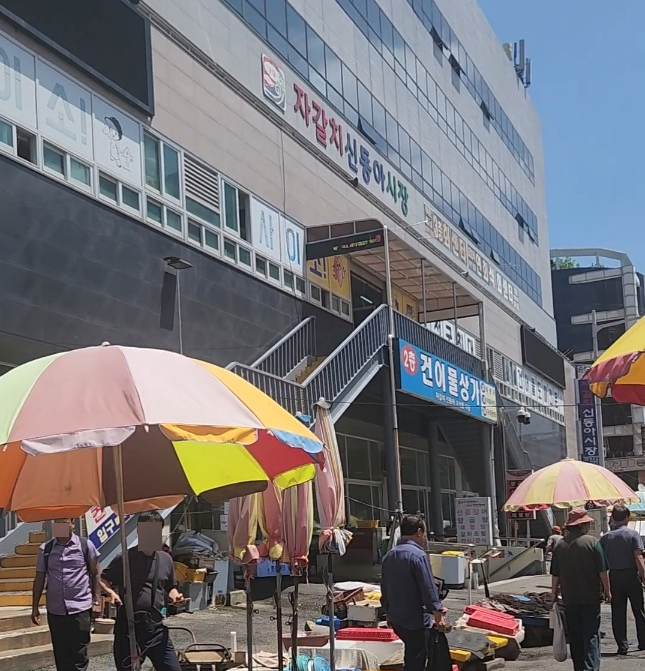
🐟 Sindonga Seafood Market (신동아수산물종합시장)
Address: 42 Jagalchi-ro, Jung-gu, Busan — about 5 minutes on foot from the main Jagalchi building.
Same Busan seafood, far more local atmosphere. One Reddit commenter described it well: “We went across to find another market, Sindonga Fish Market, and were met with very genuine vendors. We had an amazing lunch for less than we would have paid at Jagalchi.” (r/koreatravel, 2025)
Multiple Reddit reports cite average lunch costs for 2 people at around ₩20,000 here — significantly less than in the main building. A useful fallback if the main market is too crowded or too expensive for what you want.
🌊 Cheongsapo (청사포) — The Locals’ Alternative
A small fishing village on the eastern edge of Haeundae, where small restaurants sit on the rocks above the water and serve seafood while waves break beside you. No market structure, no vendors calling out to you — just a table, ocean views, and fresh seafood at honest prices.
Multiple r/koreatravel commenters specifically named Cheongsapo as “the real alternative to Jagalchi.” One wrote: “Cheongsapo is where I would go for seafood — much more of a chill vibe there down by the water.”
Getting there: Taxi from Haeundae (~15 min), or the Haeundae Blue Line Park coastal train (해운대 블루라인파크).
Reddit-recommended restaurants (search on Naver Map):
- 도헤니 조개구이 (Doheene Jogae Gui)
- 하지니네 (Hajinine)
- 해림식당 (Haerim Restaurant)
10. FAQ
BIFF Square (부산국제영화제 광장) — the Busan International Film Festival’s permanent street. Walk the handprints of Korean cinema legends, and buy 씨앗호떡 (seed-filled hotteok, ₩1,500) from the street stalls — this is the Busan street food moment.
Gukje Market (국제시장) and Bupyeong Kkangtong Market (부평 깡통시장) — connected Korean traditional market complex. Bupyeong Night Market (evenings) is a particularly good add-on.
On May 28, 2026, after visiting Jagalchi, I walked to BIFF Square and bought ssiat hotteok (₩1,500) and mul-tteok (₩1,000). That thirty-minute walk was the happiest part of the day.
Essential Korean Phrases for Jagalchi Market
| 얼마예요? | Eol-ma-ye-yo? | “How much is it?” |
| 킬로당 얼마예요? | Kil-lo-dang eol-ma-ye-yo? | “How much per kilogram?” |
| 바구니 물 빼서 달아주세요. | Ba-gu-ni mul bbae-seo da-ra-ju-se-yo. | “Please drain the basket before weighing.” |
| 신선한 거 바로 썰어주세요. | Sin-seon-han geo ba-ro sseol-eo-ju-se-yo. | “Please slice it fresh right now.” |
| 매운탕 해주세요. | Mae-un-tang hae-ju-se-yo. | “Please make the spicy fish soup.” |
| 영수증 주세요. | Yeong-su-jeung ju-se-yo. | “Please give me a receipt.” |
| 상차림비가 얼마예요? | Sang-cha-rim-bi-ga eol-ma-ye-yo? | “What is the table fee?” |
| 자연산이에요, 양식이에요? | Ja-yeon-san-i-e-yo, yang-sik-i-e-yo? | “Is this wild-caught or farmed?” |
🔗 Sources & Official Links
- Jagalchi Market official site (opening hours, closed days): bisco.or.kr/jagalchimarket
- Chosun Ilbo (Korean), Sep 6, 2025 — “자갈치 시장 상인들, 바가지요금 근절 자정 결의 대회”
- Chosun.com (English), Sep 6, 2025 — “Jagalchi Market merchants vow to end overcharging”
- Yonhap News, May 26, 2026 — President Lee visits Jagalchi Market
- Chosun.com (English), May 26, 2026 — “President Lee Jae Myung Visits Busan’s Jagalchi Market”
- KBS News — President Lee’s remarks on tourism overcharging, Busan
- Reddit r/koreatravel — “Disappointed by Jagalchi Market” (Oct 29, 2025; 44 comments; 215,903 subscribers)
- staylog.co.kr — Jagalchi Market local guide (chojangzip system detail)
- TripInfo Jagalchi Market — cooking charge and table fee data
- 인어교주해적단 — tpirates.com (real-time national seafood price platform)
- 자갈치시장 총각상회 Instagram — @chong_gak_jagalchimarket (May 2026 price posts)
- On-site visit: May 28, 2026
Did you have a great experience — or a terrible one? Either way, leave a comment. Real reports from real visitors are exactly what this guide needs to stay accurate. I read every comment and reply to all of them.

